
Surrey County Council’s Public Report on SEND: A Masterclass in Data Obfuscation
We’ve covered Surrey County Council’s somewhat selective approach to performance reporting before. But unfortunately, their latest KPI Information, contained in the ‘Public Report Pack’ ahead of the ‘Children Families and Lifelong Learning Culture Committee’ this week, is probably their most ridiculous example yet of astonishingly poor performance metric reporting.
It’s riddled with reporting inconsistencies: mixing metrics, manipulated methodology, misaligned comparison periods, and missing critical contextual performance. This approach doesn’t just confuse—it conceals. Its enough to send a Performance Analyst into deep despair. Trust us, we’ve asked a few!
But today we want to focus on one particularly concerning omission: the data line showing the number of legal appeals registered so far this year. Arguably, this is the most objective measure of whether outcomes for children and young people are improving.
And yet, yes, your eyes aren’t deceiving you… it’s been entirely obscured.

Yes. This is an actual screen shot taken from the 122 page, published Children Families and Lifelong Learning Culture Committee Agenda Reports Pack, as available on Tuesday 12th November. You can find the pack here, with the slide in question on page 113:
Anyway. Not to worry, Surrey. We’ve done the work for you. After some extremely professional peering, squinting and enlarging, we can officially confirm the following:
Cumulative appeals received during the calendar year to date:
- September 2023 : 436 appeals
- September 2024 : 823 appeals
| No. of cumulative appeals received during calendar year to date: | 436 (Sept 23) | 823 (Sept 24) |
Let that sink in for a moment.
Hmm. Perhaps its no wonder that Surrey aren’t in a rush to update their data packs. Since July, we’ve warned in our reports that Surrey’s relentless focus on timeliness was at risk of driving extremely harmful outcomes—pushing through plans quickly, at the expense of quality. Workarounds and simplifications designed to ‘speed up’ complex processes are nearly always disastrous without robust safeguards.
In early autumn, we actually saw testimony from Surrey County Council Case Officers, describing exactly that;
“We were trying to make the numbers look better. We were behind on the whole load but the newer ones were being seen before the old ones to make the numbers look better”
“They are agency staff, well-intended, but I think they are being pushed to do all this work quickly, get these plans issued, and the end result are not good plans”
“I think its being fluffed, window-dressed to make it look better than it is”.
Extracted from; Additional Needs and Disabilities, Parent and Carer Experience Task Group Report, Appendix 5.
But – apparently, despite warning, data trends, complaints, even testimony from their own frontline teams, no decisive intervention has been made and the £15 million pound EHCP Recover plan train appears to have chugged on regardless.
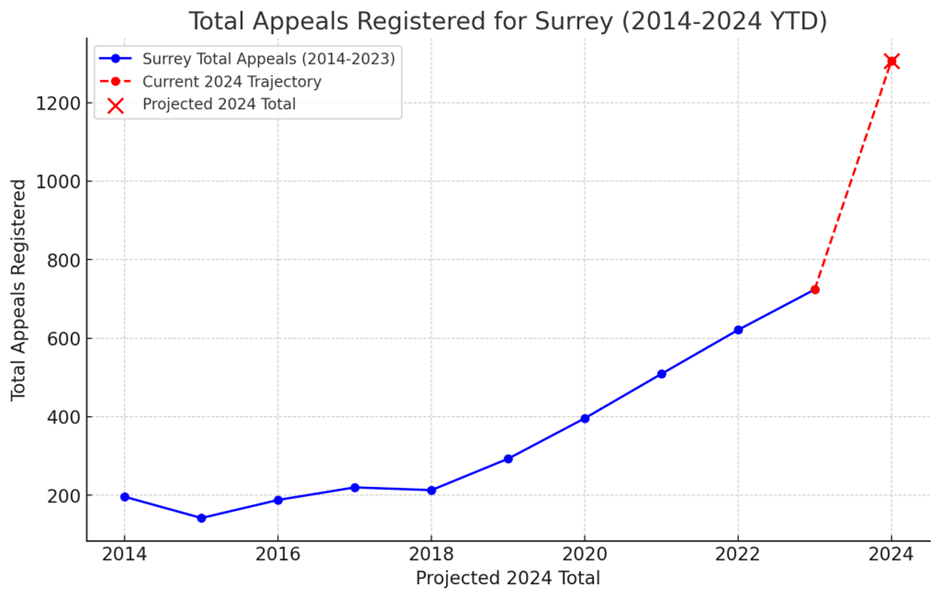
And now, five months on, Surrey is happy to claim “huge progress.” But we think the numbers are telling a different, highly concerning story: as predicted, the number of families forced to lodge legal appeals has now doubled.
Let’s be clear for those, like us, less familiar with with all of the linkages and interdependencies here—these are not frivolous appeals. Far from it. 98.7% of Ministry of Justice SEND Tribunal decisions overturn Surrey’s original decisions as they find them to be unlawful. That’s nearly every single case.
So this isn’t progress at all; it’s just accelerated the speed, scale and efficiency of heart-breaking, systematic failure.
Even worse, while Surrey reports 823 appeals as of September, parents inform us the Tribunal Service takes up to six weeks to register new appeals. This means the true number likely reflects mid-August data at best. Earlier this year, we predicted that, without substantive intervention, Surrey would likely break all records with an estimated 1,100–1,300 legal appeals registered in 2024.
Sadly, these projections now seem near inevitable.
Hiding the Truth in Plain Sight
Surrey’s latest performance pack proudly highlights progress on timeliness, but hides the only truly objective measure of their outcomes. Conveniently, the appeals data is obscured, with text superimposed over the line that tells the real story: Surrey’s SEND system is in crisis.
But behind this astonishing number; 823 appeals, are 823 families literally pushed to breaking point—families fighting for their child’s right to a suitable education. Other data recently shared suggests that many of these children are struggling to access education entirely. We are advised that parents are frequently forced to fund specialist advice themselves because Surrey blocks vital services, refusing referrals and ignoring professional recommendations. This creates an insurmountable barrier for families who simply cannot afford the expertise necessary to build their case.
The result? A two-tier system, where only those with the financial means can fight for their child’s legal entitlement, while others are left to navigate a broken system alone, with no recourse to justice. This isn’t just about obstructing services—it’s about denying families their basic rights, systemic injustice and perpetuating inequality.
The human cost is immense, and the emotional and financial toll on families is devastating. Our inbox is now—like those of Surrey’s Councillors and MPs- overflowing with heart breaking stories. Families seeking reassurance, providing examples, or just thanking us for providing a clearer picture of what’s really happening
A Call to Action
At Measure What Matters, we are committed to using data, testimony, and evidence to drive transparency and accountability in local government. But for lasting change, your voice is crucial.
At Measure what Matters, we believe that the democratic process relies on people demanding their rights and holding their representatives to account. Even when that appears hopeless (and we appreciate that this often can appear to be the case). Councillors and MPs have a duty to advocate for their communities, especially for marginalised and discriminated-against groups, who often face systemic barriers to justice and equality.
We recognise that many of you have already spoken up—and we absolutely recognise it can feel utterly hopeless when your concerns are ignored or dismissed.
But let us reassure you: in our opinion, voices are breaking through the fog. Change is slow, but we think it’s happening.
It’s critical to keep the pressure on. Use every platform available, including social media where you can—contact your Councillors, your MPs and share your experiences publicly. Share your communications and their responses where you can. Push them to demand the change that your children deserve, and to demand local accountability.
Behind every data point is a child whose entire future depends on Surrey getting this right.
We won’t stop until they do—and neither should you
Measure what Matters.
 Measure what matters.
Leave a comment