
We’re taking a slight departure from our usual data analysis work to address some growing, urgent concerns regarding reported changes in Surrey County Council’s approach to managing complaints that have emerged since our last analysis reports were published.
Firstly, we make no apologies for our relentless focus on the management of complaints in Local Government. At Measure What Matters, we believe that effective complaint handling in local government is a cornerstone of good governance. It provides a crucial mechanism for demonstrating accountability, transparency, and service improvement, serving the communities that local government is entrusted to represent, and is a window into any Council’s commitment to genuinely address public concerns and foster trust. Our analysis has already indicated that Surrey County Council’s complaint management, as well as the reporting and oversight of complaints, has been deeply flawed and we have extensively reported on these issues over the past three months.
Yet, despite this, rather than seeing any evidence of improvement, we are actually noting increased levels of feedback from families raising concerns about how their complaints are being managed.
The issues being described by families indicate changes within Surrey’s approach in responding to complaints, and raise ever more serious questions about the culture and practices shaping the Council’s response to feedback. We should also note that all of the concerns that have been flagged to us are specific to the team handling complaints about Children’s Social Care, Education, and SEND provision, who we understand are internally referred to as ‘CFLL Customer Relations Team’.
The concerns being reported by families fall into two key areas:
1. Downgrading Complaints to ‘Enquiries’:
We have received reports that complaints are increasingly being managed as ‘enquiries’, instead of being processed through the formal complaints procedures. In these cases, complainants are receiving responses from Surrey County Council (SCC) that reframe their legitimate, written complaints as ‘enquiries.’ This reclassification is seemingly being made by the team at Surrey County Council charged with managing complaints, referred to as ‘Be Heard’ (a somewhat ironic name, given the circumstances).
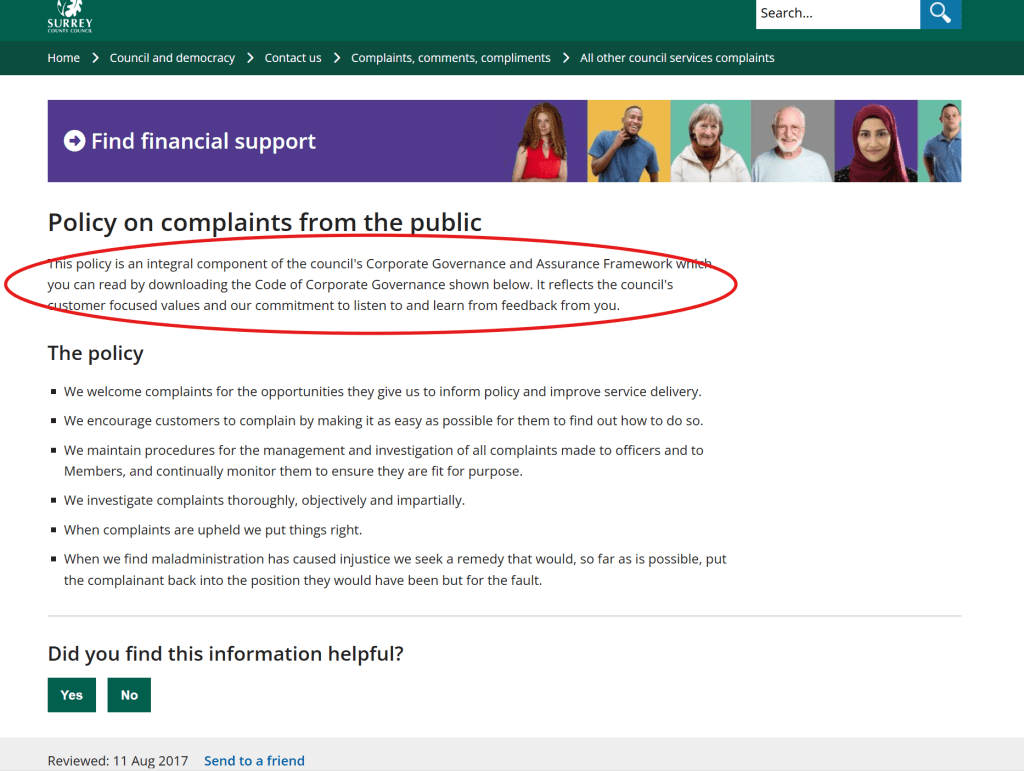
With apparently no consent, nor rationale, or justification provided for this reclassification to ‘enquiry’, it raises the question as to whether Surrey County Council is deliberately sidestepping the formal complaints process. Unfortunately SCC’s published ‘Policy on complaints from the public‘ is entirely unclear on this point, and whilst there is signposting to further information being available in a downloadable version of their ‘Code of Corporate Governance’, the link to this document does not seem to exist. Hmm.
2. Increasing Refusals to Investigate Certain Issues:
We’re also noting feedback about what appears to be increasing numbers of scenarios where complaints are being refused because they are either deemed ‘operational’; relate to a decision; involve the conduct of a Council Officer; or are associated, (however tenuously), with an issue or a period that may be subject to legal route of appeal. Yes, you’d be reasonable in wondering what is actually left to complain about! Given the systemic issues indicated with lawful decision making that we have reported on previously, and the exponential growth in appeals, we are concerned this practice will be effectively preventing hundreds of families from raising legitimate maladministration concerns, at all.
From our perspective, both these issues raise serious questions about Surrey County Council’s approach to transparency and accountability.
We would specifically define these issues as follows:
- Limiting Escalation to the LGSCO: By apparently reframing cases as ‘enquiries’ or declining to investigate, SCC effectively also denies (or delays) complainants the right to escalate to the Local Government and Social Care Ombudsman (LGSCO), who typically only reviews cases once the council’s full complaints process has been completed (for education complaints in Surrey, this would be after a Stage 1 and Stage 2 response). This reclassification essentially subverts this critical route for external review, potentially skewing oversight and accountability. More on this later.
- Avoiding Response Time Commitments: By categorising complaints as ‘enquiries,’ Surrey also sidesteps its responsibility to adhere to their committed response times as outlined in their complaints policy; a full response within 10 days. Feedback indicates that responses downgraded to ‘enquiries’ can take weeks, and in some cases, are not received at all. This practice of re-categorisation therefore appears to grant Surrey the license to respond in its own time—or indeed not at all—when issues are reclassified as ‘enquiries.’
- Potential Misreporting of Complaint Volumes: If complaints are being actively reclassified as ‘enquiries’ and subsequently, not recorded as formal complaints, it also raises serious concerns about the accuracy and integrity of all of Surrey’s internal data on complaint volumes. This practice would seriously undermine confidence in Surrey’s reporting and governance practices, which is particularly troubling given our previous findings on this issue. If data on complaint volumes are not being reported accurately, it raises more, uncomfortable questions about Surrey’s commitment to transparency and accountability, as well as its willingness to acknowledge the scale of public concerns.
At this point, we should point out that obviously any organisation should be encouraged to resolve issues as swiftly as possible. A genuine focus on early resolution of issues is to be applauded, although any issues raised should still always be carefully recorded, monitored and reviewed regularly.
However this is absolutely not what is being reported here. Instead, what is being described by families is how legitimate complaints, made through the correct channels and clearly marked as a complaint are now being responded to with a statement to the effect of;
“I am sorry to hear of the concerns you have shared with us (about x, y, and z….) Your concerns have been raised as an Enquiry.”
In some examples we have seen, this goes on to state how;
“…the complaint process runs alongside operational processes and cannot directly intervene with ongoing operational practice decisions. As such there is no role for the Customer Relationship Team at this time and we will be ceasing our involvement“.
We’re not sure this needs much interpretation – this clearly illustrates how, in relation to complaints about Children, Education and SEND Provision, Surrey County Council are seemingly subverting the legitimate complaint pathway by both re-categorising a complaint as an enquiry, and also, defining the issue as operational and therefore claiming it to be outside the remit of the complaints framework. Seemingly unchallenged. Case closed.
Imagine a resident complains to the council: “The bus on Route 22 is consistently late, overcrowded, and skips stops. This has been happening daily for weeks and is causing significant inconvenience.”
If the council responds with: “Your concerns have been raised as an Enquiry. The complaint process runs alongside operational processes and cannot directly intervene with operational decisions. As such, there is no role for the Customer Relationship Team at this time, and we will be ceasing our involvement,” it would be utterly absurd. Operational decisions and processes are precisely the areas where complaints can offer critical feedback for improvement. Missed bin collections, failure to adhere to planning timescales, poorly maintained roads…. need we go on.
It seems it’s not just Measure what Matters. raising concerns about this. We’ve found this recent LGSCO decision regarding Surrey County Council (Reference: 24-008-413). In this case, the Ombudsman stated, “We have upheld this complaint because the Council failed to consider a complaint under the children’s statutory complaints procedure.” The Ombudsman further instructed the Council to “issue a response without further delay. It will also apologise and offer to make a payment to the complainant to remedy the time and trouble they have been to.”
See: 24 008 413 – Local Government and Social Care Ombudsman
This upheld case illustrates that the LGSCO views the refusal by Surrey County Council to handle complaints properly (in this instance actually a statutory complaint) as a serious failure, underscoring in their findings that complainants have a right to the formal complaints process and it is the complainant’s decision, alone, as to whether their comments constitute an expression of dissatisfaction, or an enquiry. Yet our understanding based on the feedback we are receiving indicates that this practice may actually now be established as routine.
Our overarching concern is, of course, what these practices imply about Surrey’s culture and approach to governance. Increased scrutiny should ideally lead to more transparent, accountable, and improvement-focused practices. However, if Surrey County Council is reclassifying complaints or rejecting legitimate concerns, as is being described by families, it would suggest that Council Officers may be actively preventing the complaints system from functioning as intended. Such practice risks creating an environment where families are effectively blocked from voicing dissatisfaction, delaying resolution, and leaving families with few options other than legal action. This is deeply concerning for any public institution, let alone a Public Officers tasked with serving the community’s best interests.
Consequently, our recommendations would be summarised as follows;
Surrey County Council should provide urgent clarification of their complaint policies, and specifically ensure there is clear definition of their distinction between ‘complaints’ and ‘enquiries’ and the processes relating to each.
In addition Surrey County Council should provide public assurance that all expressions of dissatisfaction will be properly recorded and addressed under their complaints framework, including the statutory framework where it applies. Any change of categorisation to an ‘enquiry’ should only be made at the complainant’s request or with their consent
Given the growing concerns about complaint handling being raised by families, Surrey County Council should provide a specific pathway for them to raise these issues to ensure that any consequential injustice is promptly identified and rectified.
To restore transparency and public confidence, Surrey County Council should consider retrospectively correcting their public complaint data to ensure they have accurately reported all expressions of concern received through all channels.
Finally -if any complainant believes their complaint has been unfairly dismissed by Surrey County Council and they have refused to rectify this, the LGSCO should be able to provide some guidance on what to do next.
For further information about Complaint Management in Local Authorities we would recommend the following guidance;
Complaint Handling Code – Local Government and Social Care Ombudsman
Measure what matters.
 Measure what matters.
Leave a comment