
“So – do we know how we compare with other authorities in regard to these complaints in children’s services, etcetera, etcetera?”
Victor Lewanski, Chair of Surrey County Council’s Audit and Governance Committee, June 2024.
At Measure What Matters, when we identify anomalies in data or see outliers in performance trends, our method is clear: we dive back into the data, tracing where issues first surfaced, how they’ve been tracked, what actions were taken, and, crucially, who is providing oversight. This approach has proven to be an effective litmus test for an organisation’s capacity to spot underperformance and respond effectively.
In our last three reports, we’ve focused on a disturbing trend: the surge in education-related complaints in Surrey County Council compared to all other Local Authorities. Why are complaints so critical? Because they’re the most direct indicator of service quality. Complaints shine a light on dissatisfaction, reveal systemic failures, and offer insight into potential legal and compliance risks. They show how well (or poorly) an organization is meeting the needs of its most vulnerable populations. Ignoring complaints erodes trust, signals governance failures, and, ultimately, undermines public confidence.
In our opinion, in this context, they are particularly key – they demonstrate how well, or otherwise, Surrey County Council are responding to the challenging and complicated issues in the national SEN system, as experienced by all Local Authorities. And how their specific strategy, policy and practice are impacting differently on those who require their services and support.
In short—complaints matter.
The Data Doesn’t Lie—But Critical Information Has Been Missing
Surrey County Council, like many local authorities, doesn’t routinely publish internal complaint data. That alone creates barriers to transparency in Local Government that we would like to see addressed. But what’s more concerning is that critical comparative data on complaints appears to have been excluded from key reports, and despite commitments, it has repeatedly withheld from relevant committees.
The crux of the issue? Surrey County Council’s Audit and Governance Committee. This Select Committee is responsible for overseeing risk management, internal controls, and, yes, complaints. Their job is to safeguard the Council’s operations, ensure accountability, and protect public resources. This is exactly where you’d expect detailed analysis of an issue in complaint management or unexpected performance spikes; probing questions, and robust improvement plans to address what we have previously reported to be a catastrophic underperformance.
But, buried in the minutes of a June 2023 meeting, we find this:
“A committee member noted that the 30% increase in overall complaints was worrying and raised concerns about the decline in response times. He also noted that comparative figures with other similar authorities were missing from the report, despite being provided in previous years. The customer relations manager clarified that comparative figures would be included in the report scheduled for November.”
Click for Source Information
Extracted from Approved Minutes, Audit and Governance Committee, Item: Annual Complaint Performance Review, 5th June ’23
Browse meetings – Audit and Governance Committee – Surrey County Council (surreycc.gov.uk)
Wait, what? You mean key benchmark data was dropped from the report at pretty much the exact time Surrey’s relative performance started to nosedive? And what happened next? An action to provide comparative data at the November meeting.
Except that action wasn’t completed.
Instead, for 15 months, this critical action point has been rolled from meeting to meeting, with an written update each time that comparative data was proving “difficult to collate.” When finally robustly challenged by Councillors earlier this summer, the response from Surrey’s Children, Families and Lifelong Learning Customer Relations Team was to the effect of: “ …(we) don’t have the information to hand“.
Unbelievable. It transpires that Surrey County Council’s Children, Families and Lifelong Learning Directorate have seemingly been sitting on what appears to be the worst education related complaint performance in the country, and it somehow just *didn’t get round to* reporting on it?
A Deeper Systemic Failure in Education Complaints
Our ongoing analysis of the situation over the last few weeks has filled the gaps in what Surrey County Council has not provided. The findings are clear: the Children, Families, and Lifelong Learning (CFLL) team has experienced a massive spike in education-related complaints, from 2021 onwards. On review of each complaint report from the Local Government Ombudsman (LGO), its apparent these complaints are not just administrative gripes. They involve complex, serious and repeated failures in Surrey’s SEND provision.
The 37% internal escalation rate of education complaints in Surrey is an alarming sign that a significant number of issues are not being resolved in the early stages of complaint management, forcing families to escalate their concerns further. This indicates that the Council appears to be repeatedly failing to address problems, instead, allowing them to snowball into larger, more complex cases and consequently, significantly prolonging the suffering for the children and families involved in each case.
Complaints Escalated to the Ombudsman—Far from “Small”
The real depth of the crisis becomes evident when we examine complaints escalated to the Local Government Ombudsman (LGO). In 2023, 230 education-related complaints from Surrey were escalated to the Ombudsman—ten times the national median, as we’ve previously reported.
Click for report ‘Behind the Numbers: Unravelling Surrey’s Troubling Education Complaint Crisis’
Yet, despite this staggering figure, Surrey County Council’s official reports have persistently described this number as “small” and downplayed its significance. Nearly a quarter of reported education complaints in Surrey are now reaching the LGO, a clear signal of severe systemic failings that require urgent attention.
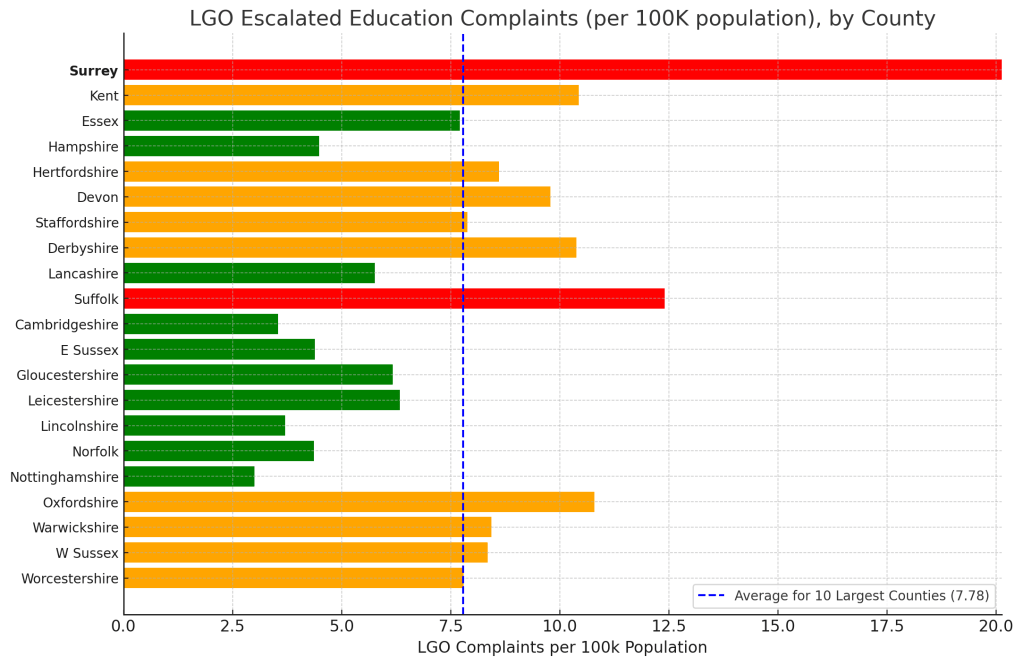
This new visual data from our most recent analysis comparing LGO escalated education complaints per 100,000 population, by the largest Local Authority Counties tells an even more compelling story.
Click for Source Information
Complaint data sourced from: Interpreting our complaints data – Local Government and Social Care Ombudsman
Population data sourced from: Population estimates – Office for National Statistics (ons.gov.uk)
Yet again, Surrey leads the chart, with over 20 education related complaints, escalated to the LGO, per 100k population– more than double the average of their comparative peer group (7.78). Surrey’s performance is a clear outlier in all cohorts, even when solely compared to large counties like Kent, Essex, and Staffordshire, which, although also above average, do not come close to the level of escalated complaints seen in Surrey. This stark contrast just further raises questions about what specific systemic failures in Surrey’s education services are causing such a high rate of escalations in education related complaints, compared to all others.
The Human Cost Behind the Complaints
But these complaints aren’t just numbers on a chart—they represent real people, many of whom are already in crisis by the time they seek help. As we’ve shared previously, the majority of families who escalate their education complaints to the Ombudsman have been battling for months, often years, to secure the education and services their children are legally entitled to. Nearly all of these complaints are specifically related to Special Educational Needs (SEN) provision, where the types of reported issues, like avoidable delays, inaction, and unlawful decision-making, can have a devastating effect on the child’s education, well-being, and future prospects.
It is apparent from our review, that behind complaints escalated to the LGO are families that have already been let down multiple times throughout the council’s statutory internal complaints process. Undoubtedly, it demands an answer as to why these specific serious complaints have remained unaddressed, for so long, despite all the safeguards that an effective complaint management process should have offered.
A Governance Breakdown That Cannot Be Ignored
Beyond the staggering financial redress, the statutory breaches these complaints represent, and what appears to be a prolonged omission of critical performance data, the most troubling aspect of this situation is the breakdown in governance it represents. The Audit and Governance Committee is responsible for ensuring that Surrey County Council operates with transparency and accountability. However, without sight of the necessary data, in our opinion, their ability to provide effective oversight has been severely compromised.
So, where do we go from here? Let’s start with these critical questions for the Audit and Governance Committee:
- When a key performance indicator—like comparative performance data—was removed from reports, why wasn’t it immediately corrected?
- Why was the action to address this left unresolved for more than 12 months without challenge?
- Now you have the comparative data you were seeking, how would having this information earlier have changed your approach?
- Lastly, what action do you propose to restore proper scrutiny and governance?
These are serious questions that demand serious answers. In our opinion, what we’re seeing here isn’t simply just a spike in complaints—it’s a failure of governance directly impacting some of Surrey’s most vulnerable children and families.
Measure what matters.
 Measure what matters.
Leave a comment