
“We can’t always meet the parental expectations, there aren’t enough, we ‘ve seen a 150% increase in requests for new EHCPs. The demand goes up, year on year”
Tim Oliver, Leader of Surrey County Council, 30th August 2024, in a broadcasted interview with BBC Surrey responding to concerns raised about their SEND services. 1
There’s a deeply unpleasant pervasive narrative about the failings in SEND provision, often attributed to an overwhelming demand—more requests for support, unreasonable parents, with funding and resourcing struggling to keep pace. However, as you’ll have seen from our previous reports, our analysis of the available data suggests a far more nuanced story.
The Real Picture: rejections, appeals and service delivery breakdown
At the national level, the trend shows a clear upward trajectory in request for special educational support, with approximately 20-25,000 new requests for assessment being received by Local Authorities each year. But when we dig deeper, variations start to emerge, particularly at local level. Take Surrey, for instance.
Variations are illustrated when you compare the growth in EHCP assessment requests in Surrey versus the national trend from 2017 to 2023. While there has been a steady increase in requests for assessment over the last five years, it is not as pronounced as the national trend. In fact, Surrey’s increase in requests has been considerably more moderate, and latterly, is now levelling off, with only 110 more requests received from 2022 to 2023—an average of just nine additional requests per month for the whole County.
The Local Shift in SEND Decision-Making
What’s even more intriguing is that Surrey Council Officers are actually reporting a reduction in new assessment requests received this year, indicating a further divergence from the broader national pattern. Not to mention this directly contradicts the unpleasant inferences and factually incorrect statement made on this point by Tim Oliver where he claimed in conversation that; “We can’t always meet the parental expectations, there aren’t enough, we’ve seen a 150% increase in requests for new EHCPs. The demand goes up, year on year.”2
Whilst the statement is plainly untrue and misleading, this also raises important questions: Is Surrey’s SEND crisis solely indicative part of a challenging national environment (which they seem peculiarly determined to maintain), or are local variations now painting a different picture?
Moreover, it’s not just the number of requests that matters, but also how they are handled. In Surrey, the rate of declined assessment requests has been rising. Last year, the Surrey County Council turned down 33.1% of initial requests for additional SEND support received from schools and parents (a whopping 154% increase on previous year). While many of these decisions were quickly reversed on legal appeal—highlighting a potential area for further scrutiny—it’s clear that Surrey has certainly become more assertive and timely in saying no.
The interesting factor here, and one often inferred in distasteful, inflammatory and highly misleading statements, is that the SEND process is fuelled by demanding, unreasonable parents. Based on the our assessments of the performance information being circulated within Surrey County Council, we suspect this may often muttered in corridors, but rarely sees light of day in official reports. So its somewhat astounding to hear this follow-up claim from Cllr. Tim Oliver, Leader of Surrey County Council this morning on the BBC;
“Often we do find that what the parents thinks is in the best interests of the child, isn’t necessarily what the experts think is in the best interests of the child”3
Yuk. Tim should know better. A quick fact check for anyone who is less aware of the intricacies of this process (and Cllr. Tim Oliver). The agreement of essential SEND support process is one underpinned entirely by professional input. Highly qualified specialists who conduct statutory assessments of need. Not parents. Lets all be crystal clear on this point. It is not parents who specify what their children need in terms of support. It is highly qualified professionals. Which, of course, is why we see the evidence that 98.3% of time, the unlawful decisions of Local Authorities to withhold access to vital services and support are reversed on appeal because a Judge will rule solely based on the evidence presented to them. Frankly, to even attempt to imply otherwise appears to misrepresent the very foundation of the SEND system. Shame on you Tim.
The Impact on New EHCPs Issued
We understand that funding becomes a significant variable factor only when an Education, Health and Care Plan (EHCP) is approved and issued. Here, Surrey’s data 4, (extracted from DfE performance reporting) takes an intriguing turn. Despite the steady increase in assessment requests, more of them are being declined, which directly impacts the number of new EHCPs issued.
This data shows that while there was a drop in EHCP issuance in 2022 due to Surrey’s processing delays—often referred to as their “timeliness issues”—the council attempted to catch up on pending cases in 2023 with a £15million investment in their ‘EHCP Recovery Plan’. However, when you balance out the demand over a 24-month period, it becomes evident that Surrey is still issuing essentially the same number of EHCP plans year on year—a trend that has remained broadly consistent since 2019.
Understanding the Data in Context
The following two key graphs we’ve included below further illustrate this point:
- Raw Data Volume of Surrey County Council New EHCPs, issued by year (2019-2023)
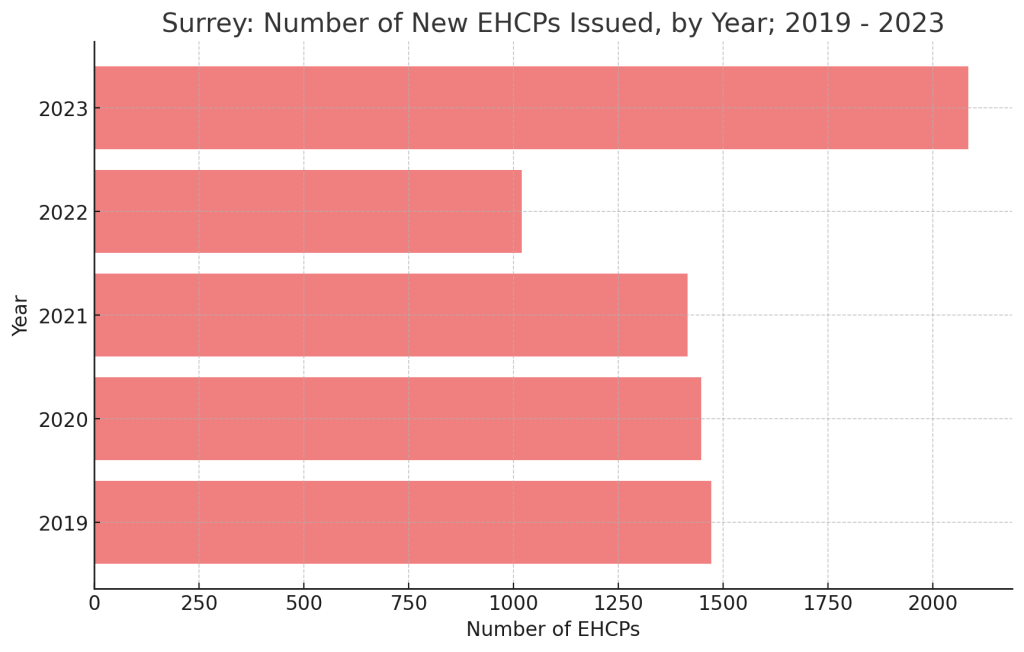
The first graph (1 )shows a consistent number of around 1,500 plans issued each year, or approximately 125 new plans issued per month. The drop in 2022, followed by a spike in 2023, distorts the understanding of demand, as it was well reported by Surrey to be more about processing delays than any actual increase or decrease in need. In real terms, this shows that they only managed to issue just over 1000 plans in 2022 (compared with their normal outturn of approx. 1500), and these others were left languishing in outstanding work piles for many months while their internal processes seemingly crashed. These were gradually picked up throughout 2023, and added back into their typical annual workflow of approx. 1500, creating what appears a false spike in demand.
2. Adjusted Volume of Surrey County Council New EHCPs, issued by year (2019-2023)
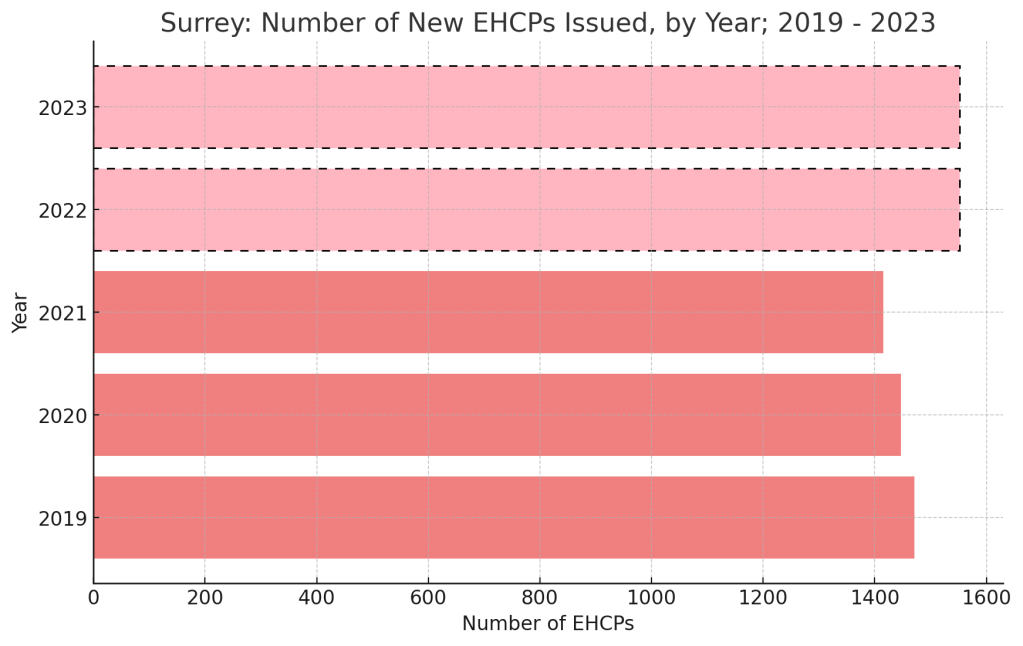
This second graph* (2) balances the data across 2 years to adjust for this spike, showing that the external demand on their services has actually remained steady despite evident issues in their processing times. There is simply no evidence in these numbers of an overwhelming increase in new plans being issued year on year, and certainly not of a bottomless pit of funding requirements with volumes of new plans spiralling out of control.
Instead, the data simply points to a broadly stable volume of new plans being issued—just not on time.
Final Thoughts: A (*repeated*) Call for Accountability and Transparency
Bringing this issue full circle, our reports are now showing that Surrey has experienced a steady increase in requests for support, but they are also declining more of these requests. The council is issuing approximately the same number of plans year on year as they were in 2019, but clearly has been struggling to maintain their workload through this period. And yet complaints have grown exponentially, and appeal rates have doubled over this same period, indicating deeper systemic issues.
Instead of confronting fact, Cllr. Tim Oliver’s polished, but inflammatory and misleading statements today 5 do an appalling disservice to the reality faced by parents, professionals, and children within the SEND system. The million-dollar question remains: Is this truly how performance is perceived within Surrey County Council? Can Councillors genuinely claim to still be unaware of these trends? While the Leader of Surrey County Council persists in this false and damaging narrative of parent-blaming, will Councillors continue to turn a blind eye to the evident dysfunction in their performance?
We would maintain that it is the job of Councillors to determinedly dig out these variables in performance, to carefully examine the national data to ensure Surrey’s performance is fairly compared to others. But if they still aren’t seeing the wood for the trees—well, in our view, that’s a severe compromise in oversight and governance.
Sources:
 Measure what matters.
Leave a comment