
As discussions intensify around the growing complaints about Surrey’s education system, it’s crucial to dig deeper into the data to understand what it truly reveals about the quality of services within Surrey County Council. Here at measure what matters we believe complaints data isn’t just a collection of numbers; it’s a critical tool for assessing the performance and accountability of public institutions. When the data suggests systemic issues, it raises serious concerns about whether those in power are fulfilling their responsibilities to the public.
The Importance of Complaints Data in Evaluating Performance
In any public service sector, the volume and nature of complaints are key indicators of overall performance and accountability. Complaints serve as a critical feedback loop, alerting authorities to problems that need to be addressed. When handled transparently and effectively, complaints can lead to improvements in service delivery, policy adjustments, and better governance. However, when oversight indicators suggest complaints may be being mismanaged or underreported, it can be a sign that more serious, systemic issues are being ignored or at worst, concealed.
In the context of education, complaints often relate to crucial issues such as access to appropriate educational support and the fairness and legality of decision-making in relation to educational provision and arrangements. This is particularly true in the realm of Special Educational Needs (SEN), where vulnerable children rely on local authorities to uphold their rights and provide necessary services. The recent article in The Guardian highlights just how critical this issue has become, with the Local Government Ombudsman (LGO), Amerdeep Somal, describing England’s special educational needs system as being in “utter disarray.”
Why Measuring What Matters Is Crucial
This brings us to a fundamental point: how do we measure what truly matters when it comes to public service performance? At Measure What Matters, we emphasize the importance of finding and scrutinizing data that genuinely reflects the effectiveness and quality of service delivery in Local Government. Complaints data, when accurately collected and transparently reported, serves as a critical measure of performance for any organisation. It highlights where systems are failing and where there is a need for urgent improvement.
In the case of Surrey, the numbers indicate not just isolated problems but a systemic issue with the way education complaints are handled. Furthermore, on closer examination, the startling increase in issues being flagged by families are indicative of serious failings in not just complaint management, but are serious red flags in the delivery of Education Services within Surrey as whole. Ignoring these indicators, or failing to properly scrutinize them, leads to a dangerous disconnect between reported performance and actual outcomes. Ensuring that the right data is measured, reported, and acted upon is essential for holding public institutions accountable and ensuring they meet the needs of the communities they serve.
Unpacking the Numbers: What Surrey’s Complaints Data Tells Us
Let’s take a closer look at the internally reported numbers coming out of Surrey, where the data paints a troubling picture. Local authorities like Surrey aren’t legally required to regularly publish the number of complaints they receive, nor are they obligated to provide a detailed breakdown of these complaints. This point, itself, is one we would like to see addressed. However, they are as a minimum, expected to have some form of governance function to review and address complaints. In Surrey, this responsibility lies with the Audit and Governance Committee, which commissions an annual performance report—the best window we have into the situation.
If someone is unhappy with how their complaint has been handled, they have a few options. First, they can do nothing—a choice we suspect many people reluctantly make, unfortunately leaving those complaints as invisible data points. Second, they can escalate the issue to their Councillor or MP. Last year, 1,400 people in Surrey chose this path, with a staggering 75% of those issues related to education. We suspect people generally have been battling an issue for sometime, before taking their concerns to their MP or Local Councillor and this is seen as a last resort. So (in our opinion) this figure alone should have raised serious red flags about the state of educational services in the county and we’d love to know how these have been handled.
The third option is to take the complaint to the Local Government Ombudsman (LGO). The LGO data provides more transparency than local authority produced data, though unfortunately there are still significant gaps in the data they share. Nonetheless, the LGO’s reports offer crucial, external insights into the scale of the problems.
In our previous report, you’ll recall the figure of 230 education-related concerns* in Surrey that were escalated to the LGO in 2023—a figure ten times the national median. This stark difference isn’t just an anomaly; we believe it signals a deeper, systemic issue within Surrey’s education system. But what does this number really tell us?
*Interpreting our complaints data – Local Government and Social Care Ombudsman
Visualizing the Growth of Complaints
To further illustrate this point, consider the following chart, which compares the cumulative growth of education-related complaints to total complaints received by Surrey County Council from 2020 to 2023:
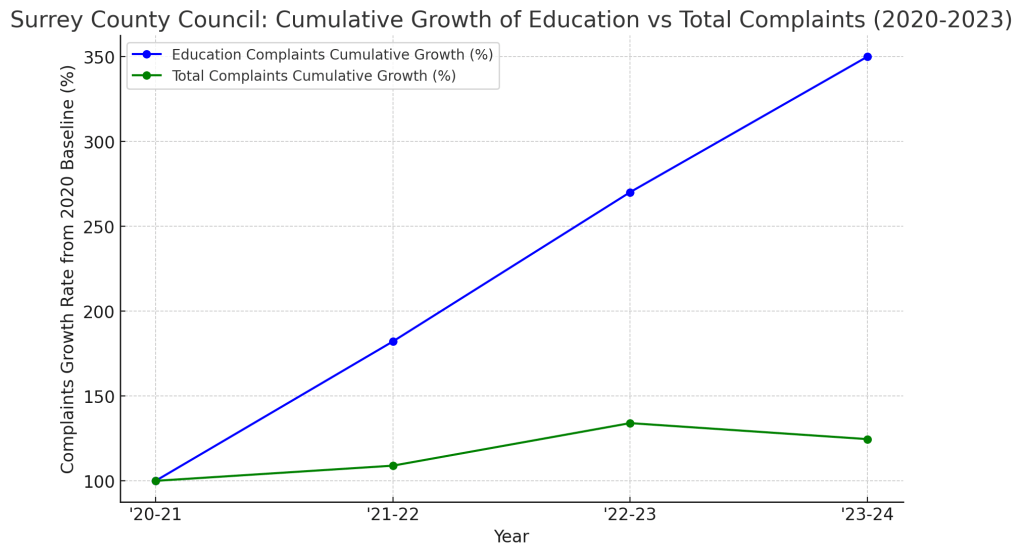
Complaint Data extracted from Surrey County Council Annual Complaint Performance Report; Audit and Governance Committee; June ’24 Item+6+-+Annual+Complaints+Performance+Report.pdf (surreycc.gov.uk)
The chart shows a sharp and consistent increase in education-related complaints, with the growth rate surpassing 350% by the 2023-24 period, compared to the 2020 baseline. In contrast, the total complaints across all services show only a modest increase. This stark difference underscores the severity of the issues specifically within Surrey’s education services.
The Complex Reality Behind LGO Data
First, it’s important to understand that this number reflects how many people tried to escalate an education-related issue. The word “tried” is key here, as there are several complicating factors. One major issue is that the LGO is barred from investigating complaints related to education if there’s an ongoing legal appeal. This limitation is particularly problematic in Surrey, where the process for securing legally mandated educational support has been described as highly challenging with one of the highest rates of appeal nationally. Many families are forced into legal appeals because the local authority isn’t following the law—a point highlighted by the Ombudsman’s recent critique of the national system.
Consider this angle: the appealable rate we previously discussed indicates that (a minimum of) 4.7% of all education-related decisions made in Surrey are not merely incorrect—they’re likely unlawful. When viewed through the lens of public office and the Nolan Principles, this statistic is astounding. The situation worsens when you consider that 98.3% of the time decisions are legally challenged in a tribunal, they’re found to be unlawful. This is not just a matter of poor decision-making; it’s indicative of a fundamental failure of governance. But – we’ll cover this point separately in a later article where we plan explore the specific issues relating to legal appeals, and what this says about governance, accountability and oversight in Local Government.
However, while the LGO highlights systemic challenges across the country, our concern is focused on the particularly acute localised issues – something the raw numbers make impossible to ignore. Surrey’s levels of issues escalated to the LGO far outweigh those of its peers. And have done so now for the last 2 sets of published LGO data. So, what does this say about Surrey, and the relative performance of other local authorities? Reports that ignore these discrepancies in the data and assume or imply a uniform performance across all local authorities is not just misleading—it’s utterly false.

Complaint Data extracted from: https://www.lgo.org.uk/assets/attach/6627/Annual-Review-of-Local-Government-Complaints-2023-24.pdf
Inadequate Governance and Scrutiny in Surrey’s Response
To consider this from the angle of effective governance, we’ve taken a bit of deep-dive into Surrey’s County Council’s various Committees tasked with oversight and scrutiny.
In Surrey County Council’s “Annual Complaints Performance Report”*, made to the Audit and Governance Committee, it acknowledges a 30% increase in education complaints* from previous year, yet we would contend that the report’s approach to addressing this alarming trend seems insufficient. The report appears to treats the exceptionally high internal escalation rates—where 37% of education complaints moved to a second stage of investigation*—as a routine procedural matter rather than a significant indicator of deep-rooted problems.
Moreover, it is important to highlight that complaints related to education services are not merely administrative grievances—they fall under statutory complaint areas, meaning that these complaints involve legally mandated responsibilities that the local authority is obliged to fulfill. Failure to properly address these complaints can result in significant legal and financial consequences, as well as profound impacts on the lives of vulnerable children and families. The statutory nature of these complaints adds a layer of seriousness that, in our opinion, that report does not adequately address. The report’s reliance on procedural tweaks and staff training to address these issues overlooks the fact that Surrey is an outlier in complaints performance. More concerning is the report’s downplaying of the seriousness of these escalations, referring to the number of complaints reaching the LGO as “a small number” and asserting that “the vast majority are successfully resolved and responded to by the Council”* To our eyes, this characterization is highly misleading given the volume and severity of complaints. After all, given we are talking about nearly a quarter of Surrey’s reported education complaints seemingly being referred to the LGO, that’s certainly not a figure you’d want to dismiss as insignificant unless you’re trying to redefine the word “small”. This might also be the moment to note that within their Annual Complaint Performance Reports, Surrey have actually been describing this escalated LGO volume as “small”, consistently for the previous 3 years. Seemingly without challenge or further scrutiny.
Information extracted from Surrey’s ‘Annual Complaint Performance Report ’23-23’, which can be read in full here: (Item+6+-+Annual+Complaints+Performance+Report.pdf (surreycc.gov.uk).
Minutes from the Audit and Governance Committee (which took place on 5th June ’24), discussing this report can be read in full here; Agenda Template (surreycc.gov.uk)
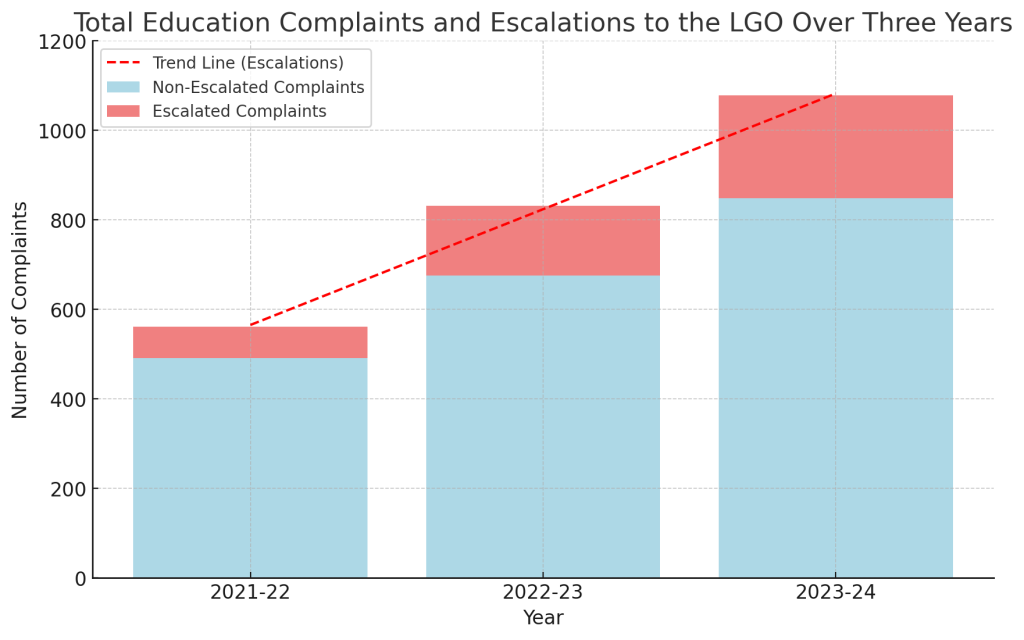
Now – a little bit of a health warning with this graph. We understand that given the nature of complaints, and particularly those serious enough to be flagged to the Local Government Ombudsman, timelines can be pretty extended. So complaints may move across timescales as an LGO investigation can routinely take several months to complete. But based on our simple analysis of the available data, it is, without question, somewhat misleading to be repeatedly describing the “vast majority” of education complaints to have been resolved internally, without escalation.
Furthermore, the staggering £540,611.59 paid in financial redress—doubling the previous year (which was, already, an all-time high) – should undoubtedly have triggered a rigorous examination of the systemic failures within Surrey’s education services, and detailed efforts to understand their relative position. Instead, our concern is that the report continues to presents these payments as a necessary response rather than recognising the scale of their specific underperformance compared to others and the indicate of severe prolonged misjustice for the families involved. Nor that these complaints have been passed onto the LGO without these issues having been already addressed by SCC. Nor have we been able to identify any effective actions targeted to interrogate specific local factors driving this significant disparity in performance compared to others, rather than the reported ‘national’ symptoms of the challenges within the SEN system itself. As we talked about in our previous report, perhaps the most concerning point of all is that it is important to note that it is believed that only a very small fraction of eligible families are estimated to be aware of or have the resources to determinedly pursue Local Authority service failings with the LGO. Concerningly, this also would suggest that the scale of any malpractice and / or maladministration identified by the LGO in their findings (and the consequential impact to families and vulnerable children) could be many times greater than here indicated.
Conclusion: The Need for Greater Accountability
In light of these findings, it’s clear that Surrey’s handling of education complaints, the reporting of their complaints, and the consequential scrutiny and oversight being applied by elected Councillors all warrants a much closer examination. The data not only highlights significant failings in governance and transparency but of course it clearly points to a system that is struggling (seemingly more than most) to meet the needs of its most vulnerable residents. As The Guardian article emphasizes, the broader context of a national system in disarray only adds to the urgency of addressing indicated local issues rather than shrugging these off as simply part of a challenging national environment. It is our opinion that whilst the Ombudsman must acknowledge the national systemic challenges, we must not overlook the alarming bandwidth of issues within Local Authorities. The reported levels of escalated issues to the LGO suggest that Surrey’s performance is far from typical—and in our opinion, ignoring this disparity would be not only inaccurate but also highly misleading.
At Measure What Matters, we are particularly concerned with identifying the data that best indicates performance in Local Government and ensuring that it is subjected to proper scrutiny. We believe the situation in Surrey demonstrates the critical importance of this approach.
When data and reports are not accurate or incomplete, oversight is critically impaired. What is missing from the data can be just as important as what is reported. In our view, the persistent downplaying of these issues—attributing them merely to a broader national crisis—appears to have been a highly effective way for Surrey to continue to divert the debate. For effective governance, scrutiny, and oversight, councillors should be demanding accurate, benchmarked, and relevant data. The numbers, after all, suggest that there’s much more beneath the surface that needs to be addressed.
Measure what matters.
 Measure what matters.
Leave a comment