
Measure what matters.
Executive Summary
This report delivers a brief, deep-dive analysis of the performance of Surrey County Council’s (SCC) Children, Families, and Lifelong Learning (CFLL) team in its duty to provide education services for vulnerable children with Special Educational Needs and Disabilities (SEND).
This report will describe how, despite significant additional investment and strategic initiatives, Surrey County Council’s deterioration in performance has seemingly accelerated in critical areas. They are still consistently failing to meet statutory requirements relating to procedural timescales, but also most importantly, there is also significant deterioration evident in metrics indicating the quality of provision being agreed through SEN process within Surrey. Outcomes for children and young people with SEN are predominantly determined by the quality of provision delivered. Speed, at the cost of quality, carries enormous risk for the progress and educational outcomes of this highly vulnerable population of children and young people.
Perhaps most importantly, this report will demonstrate that SCC is a significant outlier when compared to other Local Authorities, and national trends in these important quality metrics. The underperformance indicated within this report is not merely following national trend, but rather demonstrating a deterioration in performance that appears to be at a far more significant pace and scale than other Authorities.
The measures reviewed here are key, external outcome metrics which are typically more impactful than internal procedural measures. All measures cited are drawn from clear, specific, quantifiable external data that can be consistently tracked over time, showing trends and areas of deterioration. By considering external metrics like complaints and appeals, this report reflects the real-world impact on stakeholders, particularly the family and children who rely on these services, rather than internal metrics that typically focus more on process and efficiency rather than outcome. Furthermore, the use of external metrics enhance transparency and credibility, providing external validation of performance issues and legal confirmation of failures.
Key Findings:
- Persistent Decline in EHCP Timeliness:
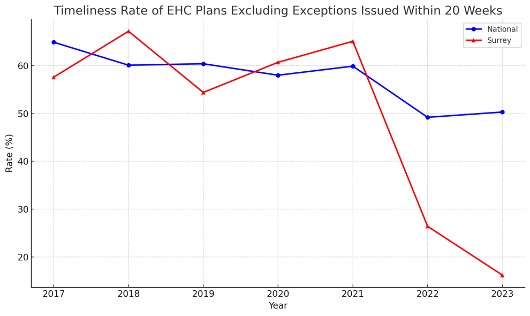
Over the past six years, SCC’s timeliness in issuing Education, Health, and Care Plans (EHCPs) has nosedived from 57.6% in 2017 to an alarming 16.2% in 2023, now starkly contrasting with the national average of 50.3%.
Despite reported progress, investment and initiatives such as SCC’s ‘EHCP Timeliness Recovery Plan’; performance actually worsened during 2023 (in contrast to the National average which had largely stabilised over this period), and progress to return completion rates within statutory timeframes in Surrey have taken considerably longer to resolve than anticipated.
2. Severe Quality Compromise:
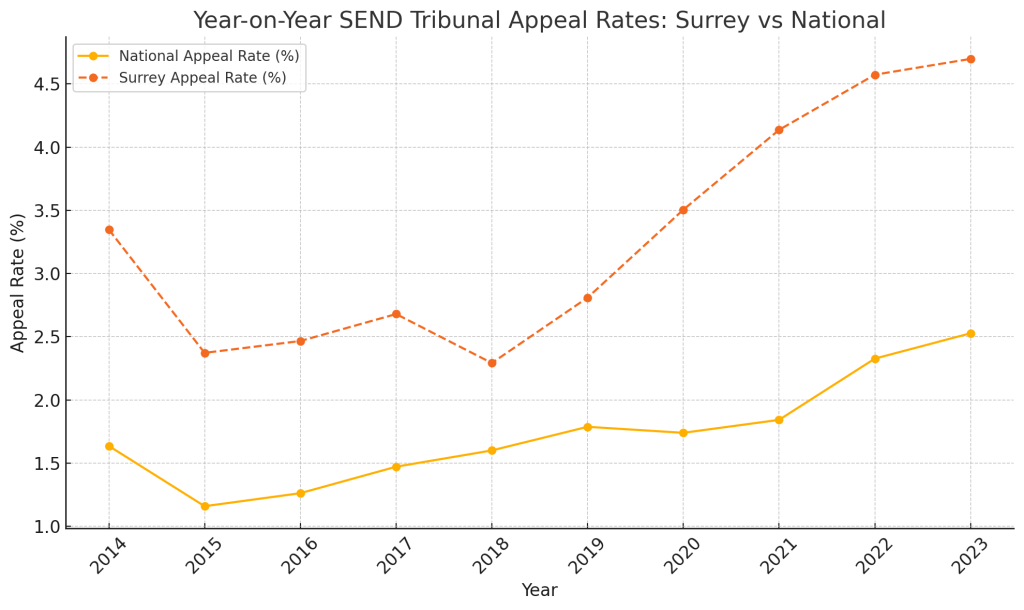
However, more importantly, the council’s apparent (and arguably disproportionate) focus on meeting deadlines has seemingly precipitated a significant decline in the quality of EHCPs over the same period, consequently risking the actual delivery of appropriate educational provisions and outcomes for vulnerable children. There has been a dramatic increase in decisions being appealed to SENDIST within Surrey, which has escalated from 2.5% in 2014 to a high of 4.7% in 2023, (one of the highest appealed decision rates, nationally) underscoring the worsening quality of decision-making. This report will demonstrate that the gap between SCC and other authorities has also widened considerably during this period, with significant and prolonged divergence from the national position. Given parents won 98.3% of these appeals in 2023, this indicates increasing, systemic failures in lawful decision making within SCC at a scale which appears to dwarf other Local Authorities.
3. Alarming Levels of Complaints and Governance Failures:
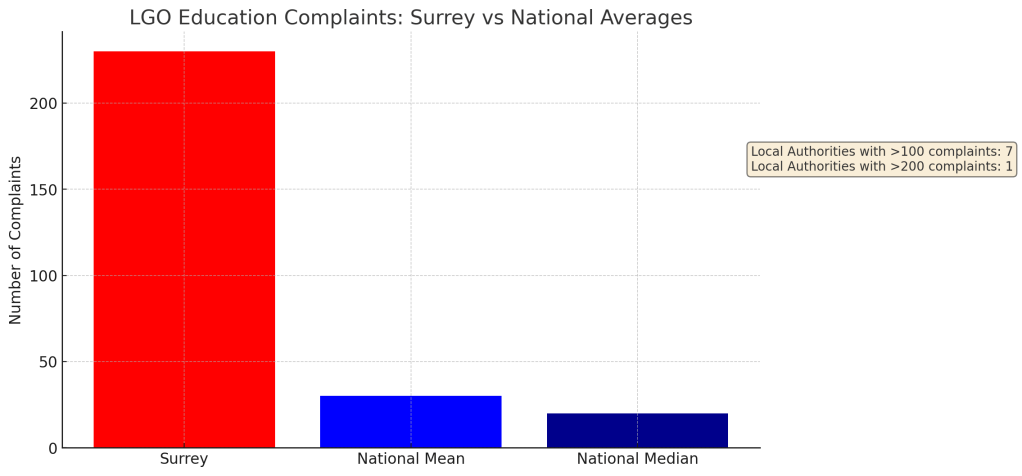
SCC has an exceptionally high number of complaints in Education and Children’s Services, compared to other Authorities, with 230 cases escalated to the Local Government Ombudsman during 2023- 10 times the national average*. These complaints often appear to involve severe, repeated breaches of statutory and legal duties.
Notably, on review of key documents, the council’s governance structures have seemingly failed to identify the extent to which SCC is an outlier, nor the scale of underperformance and therefore have failed to address these critical issues. There is a persistent absence of essential outcome performance data from reports and committee meetings, raising serious questions about the apparent absence of robust governance, controls and oversight.
Conclusion:
The report lays bare the scale of comprehensive, deteriorating underperformance in SCC in the key outcome metrics identified, and is suggestive of systemic problems within SCC CFLL team. The data demonstrates how many of these issues are arguably not national, rather, local, but repeated at a scale which has undoubtably created significant additional pressure on the National SEND System as a whole. It suggests that what appears to have been a prolonged, relentless focus on procedural timeliness has arguably led to further compromise in the quality of decision making, and therefore, inevitably, delivery of appropriate SEND provision for children and young people in Surrey.
This strategy appears to have contributed to dramatically escalating complaints and tribunal appeals volumes, but despite this, appears to have remained largely unchallenged, suggesting a profound governance failure.
Based on the evidence, it is our opinion that immediate and decisive action is essential to overhaul SCC’s management approach in relation to securing SEND provision for children and young people within Surrey. The focus must shift to measuring outcomes that reflect the quality of educational support being provided for vulnerable children in Surrey. Adherence to the Nolan principles—selflessness, integrity, objectivity, accountability, openness, honesty, and leadership—is crucial. It is our opinion that only through redirecting focus and resources towards improved scrutiny and transparency, can public trust in SCC’s delivery of educational services for children and young people with SEND be restored.
Key Data References:
1. https://www.gov.uk/government/statistics/education-health-and-care-plans-england-2024
3. https://www.lgo.org.uk/assets/attach/6630/1-Complaints-Received-23-24.xlsx
The Cost to Quality
Surrey County Council (SCC) Children, Families and Life-long Learning Team (CFLL) performance in relation to Special Educational Provision has purportedly remained a high priority for SCC throughout the last 5 years. A ‘Multi-Agency EHCP Timeliness Recovery Plan’ has been in place since 2022, focused on improving timeliness and completion rates- both longstanding issues needing attention. It is understood that an ‘end to end’ review of the EHCP process has also recently been undertaken and reportedly, actions remain in place.
Law states in the Special Educational Needs and Disability (SEND) Regulations 2014 at: Regulation 13 (2) – the local authority must finalise the EHC plan ‘ as soon as practicable, and in any event within 20 weeks of the local authority receiving a request for an EHC needs assessment’. SCC performance has historically fallen significantly short of this legal requirement, as low as 6% of EHCPs were delivered by SCC within statutory timescales in December 22’. A summary of this year on year performance is shown below and it is evident that, despite the investment, focus, interventions and heavy emphasis on timeliness measures, little sustained effect has been seen so far. Whilst improvements in timeliness are finally projected to be delivered by the mid-point of ‘24, the question becomes, at what cost has this eventual improvement been made?
Timeliness rate of EHC Plans issued within Statutory Timeframe of 20 weeks
Data Source: Education, health and care plans, Reporting year 2024 – Explore education statistics – GOV.UK (explore-education-statistics.service.gov.uk), Department for Education (DfE)
1: Timeliness Rate of EHC Plans Excluding Exceptions Issued Within 20 Weeks (Surrey vs. National, 2017-2023)
Key Points: The timeliness of issuing EHC plans in Surrey has seen an accelerating decline over the previous 3 years, creating a severe and widening gap over this period compared to the national average.
Findings
- Surrey’s timeliness rate dropped from 57.6% in 2017 to an all time low of 16.2% in 2023.
- The national average also declined but at a far lesser rate, stabilising by 2022 with an improvement to 50.3% in 2023.
- The gap between Surrey and the national rate has actually widened dramatically, most notably in the last two years.
This simple review of open-source data reveals how this focused management attention primarily on targets for issuing and administering to EHCPs within statutory timeframes has not only been largely ineffective for a prolonged period, but also most importantly, may have actually contributed to the significant deterioration now evident in the quality of the EHCPs and consequently, delivery of the provision attached to them over this same period.
Lack of emphasis or oversight on quality, outcome, or fulfilment of statutory responsibilities relating to quality (for example thorough assessment, plan specification and appropriate placements), severely impacts the actual delivery of educational provision and therefore, outcomes for vulnerable children, with serious consequences. Without a balanced, rounded and well-informed view of the performance of this team, there’s a risk of unnoticed underperformance, unintended consequences, and at worst, opportunities to ‘game’ the metrics, presenting a false illusion of progress and improvement.
Put simply, securing the ‘right’ support for a child is as important, if not, more important than speed in terms of achieving sustained, positive outcomes for children and young people with SEND. To achieve neither is undoubtably devastating for the future prospects of this highly vulnerable population.
When considering CFLL team performance, indicators like complaint levels and tribunal rates provide crucial, objective and independent insight into the quality of the work being delivered by the CFLL teams and how it affects outcomes for children and young people with SEND. Both the Local Government Ombudsman (LGO), and the Ministry of Justice (MoJ) publish open-source data to share national and localised performance trends, but concerningly this information appears to often be either entirely missing within reported metrics for the CFLL teams or buried within broader reports and metrics without context.
The next graphs provide an outline of the scale of underperformance of SCC in these critical outcome based measures, and both trends over time, and performance comparison with National averages.
The consistent absence of these key metrics, commentary or related actions in Committee reports raises serious questions about the priority, and operational strategy of SCC in relation to the delivery of SEND provision, especially when the devastating impact on children and families behind each of these appeals and complaints is reportedly well understood.
2: Significant Increase in Surrey SEND Tribunal Appeal Rates (2014-2023)
Key Points: This line graph focuses on the trend in Surrey County Council’s SEND tribunal appeal rates over a decade. This is the rate of decisions, made by CFLL which have been appealed to HMCTS SENDIST (Ministry of Justice)

Findings:
- This data provides an objective indication of the quality of decision making in relation to providing critical support for children and young people with SEND.
- The appeal rate in Surrey has risen sharply from around 2.5% in 2014 to 4.7% in 2023. This is now one of the highest appeal rates, nationally.
- There is a notable upward trend, especially in the last 5 years, indicating a worsening issue with the decision making related to EHCPs with Surrey.
- In 2023, parents won 98.3% of all appeals heard by HMCTS. In many cases, these children will have therefore been with inadequate educational provision for more than 12 months preceding appeal.
Data Source: SEND_Appeal_Rate_Table_2023.ods (live.com), Ministry of Justice, 2024
3: Relative performance ratio of ‘appealed decisions’ year on year.
Key Points: This line graph illustrates the appeal rates over time, comparing Surrey County Council’s performance with the national average.
Findings:
- The red line representing Surrey shows a sharp incline in appeal rates from 2014 to 2023, now peaking at over 4.7% in 2023. There were 724 appeals lodged against SCC in 2023, compared to a national average of 45 per local authority.
- The national average, indicated by the dashed line, remains much lower over the same period.
- Surrey’s performance continues to significantly deviate from the national average and would indicate that systemic poor decision making relating to SEN provision is not so much a national problem, rather a Surrey problem.
Data Source: SEND_Appeal_Rate_Table_2023.ods (live.com), Ministry of Justice, 2024
This published Ministry of Justice data provides critical insight into the quality of decision making of the CFLL team. It shows significantly increasing appeals (all the while focus has apparently been on timeliness), with SCC’s total decisions in relation to EHCPs now being appealed at an all-time high rate of 4.7%; one of the worst rates, nationally. The continued gap between Surrey’s performance, other Authorities suggests these issues are not, in fact, simply reflective of a challenging national picture, as often seems to be inferred within committee reports and minutes, but instead, indicative of severe, systemic failure in the quality of decision making in Surrey. Perhaps most concerning is that the scale of this underperformance, in one of the largest Local Authorities, will inevitably create significant national pressure on the SEND system as a whole.
When examined, other open-source data reveals similarly troubling trends.
Total Education & Children’s Services Complaints escalated to the Local Government Ombudsman
Key Points
Surrey’s education complaints are alarmingly higher than most other local authorities, revealing critical issues in their education services.
- Surrey’s 230 education complaints (escalated to the Ombudsman for review) exceed the national mean and median, highlighting severe deficiencies in issues leading to complaint, and the complaint management process itself.
- Only one local authority (Surrey) have education issues escalated to the LGO exceeding 200, placing Surrey in a critical spotlight.
- Nearly ten times the complaints: Surrey’s LGO escalated education issues have now remained ten times higher than the national median for the last 2 years, starkly illustrating its underperformance compared to all other regions, and all other areas for complaint.
Data Source: Local government complaint reviews – Local Government and Social Care Ombudsman
According to the LGO data release, SCC had the highest number of education-related complaints escalated to the Local Government Ombudsman in both ‘22-23, and ‘23-24—nearly 10 times the national median volume. In order for a complaint to reach the LGO it must, first, have been investigated at both Stage 1 and Stage 2 of SCC internal complaint procedures. Therefore, this total reflects serious, escalated issues, many of which appear to relate to serious breaches in statutory and legal duties which have repeatedly failed to be addressed by SCC. These complaints will have remained unresolved for many months before finally arriving with the LGO, supposedly with all internal complaint processes and investigations having been fully signed off by the complaints teams within SCC.
This astounding disparity in SCC performance compared to all other Local Authorities suggests repeated, comprehensive, service failure, not just within the CFLL teams but also in the effectiveness and objectiveness of education complaint management processes within SCC. The LGO ordered SCC make restorative compensation payments of over half a million pounds in 2023, presumably in response to some of the 230 complaints indicated here. The most recent commentary issued by the LGO describes how their casework is now ‘dominated by complaints about Special Educational Provision’, and how ‘young people and their families don’t get the help they need and lose vital weeks , months, and years of education as a result.’ Again, the data would suggest that whilst education complaints are increasingly nationally; the vast disparity in SCC’s performance in education related issues compared to others simply cannot be ignored.
extracted from: https://www.lgo.org.uk/assets/attach/6627/Annual-Review-of-Local-Government-Complaints-2023-24.pdf
It is important to note that it is believed that only a very small fraction of eligible families are estimated to be aware of or have the resources to determinedly pursue Local Authority service failings with the LGO. Concerningly, this also would suggest that the scale of any malpractice and / or maladministration identified by the LGO in their findings (and the consequential impact to families and vulnerable children) could be many times greater than here indicated.
Critical Failings in Governance
The role of elected County Councillors is critical in ensuring good governance and integrity of decision making within local authorities. Councillors must rigorously oversee, interrogate and challenge the narratives provided by senior leaders to align with the Nolan principles, prioritizing public interest and service quality.
There is Statutory Guidance in relation to the specific roles of Director of Children’s Services (DCS), and Lead Member for Children’s Services (LMCS), issued by the Department of Education. Their responsibilities are defined in the legal framework as follows;
“The DCS has professional responsibility for children’s services, including operational matters; the LMCS has political responsibility for children’s services… The DCS and LMCS should each have an integrated children’s services brief, ensuring that the safety and the educational, social and emotional needs of children and young people are central to the local vision. Between them, the DCS and LMCS provide a clear and unambiguous line of local accountability”.
Extracted from :https://assets.publishing.service.gov.uk/media/5a7c9fbbe5274a30fa38ff4c/directors_of_child_services_-_stat_guidance.pdf
The Local Government Association describes how each council must take appropriate measures to gain assurance both of the performance of its services and of its corporate governance. Specifically their guidance describes how ‘assurance can only be gained through a series of nuanced, qualitative judgements… It is essential to triangulate numerous sources of evidence, and to apply multiple assurance activities effectively, to gain a view of the council (performance) in the round’.
Extracted from: https://www.local.gov.uk/publications/improvement-and-assurance-framework-local-government
It is the duty of Councillors to represent and advocate for those they have been elected to represent, arguably even more so those in highly vulnerable communities who have both an increased dependency on Public Services and are potentially less able to advocate for themselves.
Instead, published meeting records suggest that only a few voices within the County Councillors are consistently recognising this team to be underperforming, persistently flagging concerns and challenging the performance and priorities of the CFLL team and the Cabinet for Children, Families and Lifelong learning. The availability of vital, insightful data (such as that shared within this report) should have served to inform these concerns. Yet the apparent absence of critical information from papers in key committees, raise the possibility of a lack of understanding, incompetence; or at worst, an attempt to withhold key information, any of which would indicate a catastrophic failure in oversight and governance by both the Cabinet for Children, Families and Lifelong learning. Notwithstanding, this raises serious questions that should be answered about whether the true performance and impact of SCC CFLL for children and young people with SEND has been fully understood, and whether appropriate measurable intervention can be evidenced relating to the specific areas of concern highlighted within this report.
The following committees are all identified in this report as having some degree of oversight responsibility for the performance metrics described within this report;
Surrey County Council Audit and Governance Committee: https://mycouncil.surreycc.gov.uk/ieListMeetings.aspx?CId=168&Year=0
Surrey County Council Cabinet Member for Children, Families and Lifelong Learning Decisions: https://mycouncil.surreycc.gov.uk/ieListMeetings.aspx?CId=168&Year=0
Surrey County Council Children, Families and Lifelong Learning Culture CommitteeBrowse meetings – Children, Families, Lifelong Learning and Culture Select Committee – Surrey County Council (surreycc.gov.uk)
Conclusion
The analysis highlights the significant and persistent issues within Surrey County Council’s, Children, Families, and Lifelong Learning team, specifically in the provision of services for children with Special Educational Needs and Disabilities (SEND). The data suggests that despite ongoing efforts and investment, SCC has historically failed to meet statutory requirements for timeliness but also seen a troubling deterioration in the quality of Education, Health, and Care Plans (EHCPs) over this same period, when compared to other authorities.
This has led to a dramatic increase in tribunal appeals and complaints, reflecting what appears to be a systemic breakdown in both service delivery and also, governance. The current approach, which appears to be disproportionately focused on procedural timeliness at the expense of quality, has proven both slow, and largely ineffective but also, consequently detrimental to the vulnerable children, young people and families it aims to serve.
However, most concerning of all, this analysis indicates that critical governance structures in place have failed to either identify, nor adequately address these issues, indicating a need for comprehensive reform in the way that performance is consistently measured, understood and shared openly to ensure effective oversight and governance can be restored.
Recommendations
The following are examples of transparent reporting improvements which could be adopted to support effective governance;
Create a Real-Time Digital Dashboard for Stakeholders: – Develop an interactive, real-time digital dashboard accessible to all stakeholders, including parents, educators, and councillors. This platform would provide accurate, up-to-date information on the status of EHCPs, track performance metrics, and allow for real-time feedback and engagement.
Establish a Dedicated, Independent, Quality Assurance Unit: – Form a specialised, fire-walled team within CFLL focused solely on quality assurance. With fully separated reporting lines, this unit could conduct objective audits, monitor compliance with statutory requirements, and implement continuous improvement initiatives based on best practices and stakeholder feedback.
Introduce a Transparent, Outcome focused, Annual Performance Report: – Publish an annual performance report that transparently details achievements, challenges, and future plans. This report should include specific agreed internal and external metrics, case studies, and open sourced testimonials to provide a holistic, objective view of the council’s performance and foster accountability for both the end to end process, but also, outcomes achieved.
Measure what matters.
 Measure what matters.
Leave a comment